
Claude for Teachers: Anthropic Wants Claude Inside the Daily Workflow of U.S. Teachers
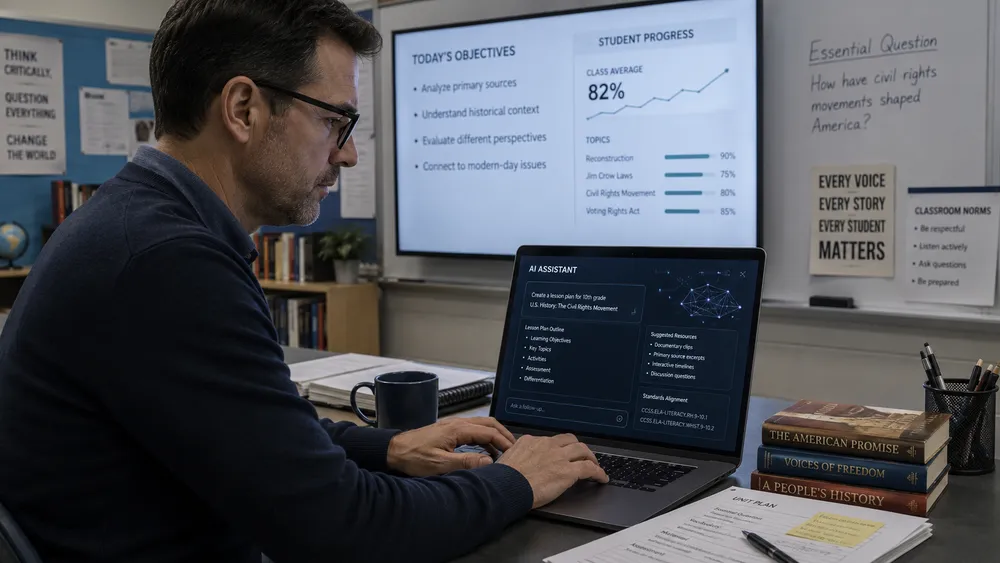
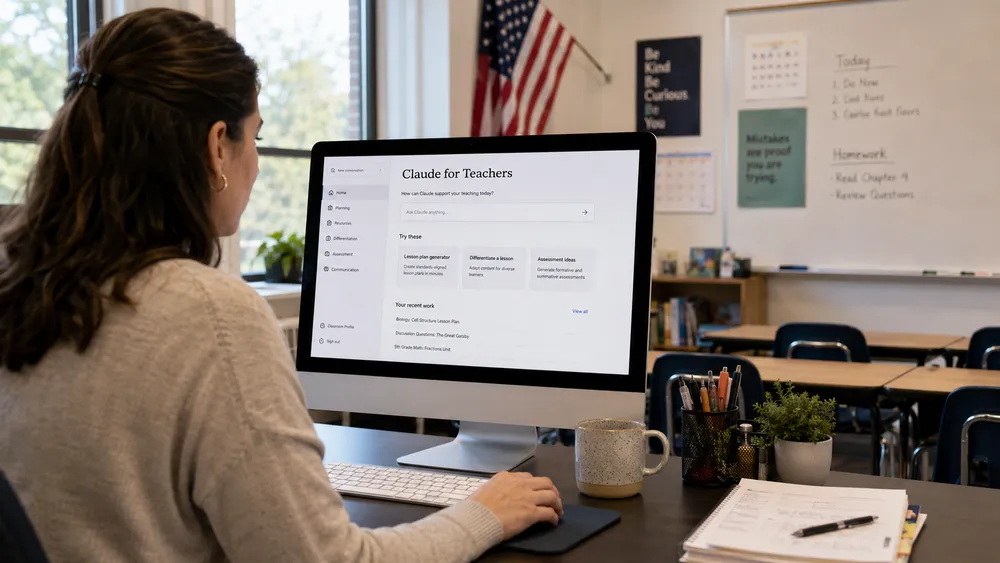
Anthropic has launched Claude for Teachers, a new free offer for verified K-12 teachers in the United States. Announced on July 14, 2026, through the Anthropic Newsroom, the program gives eligible educators access to premium Claude capabilities, a library of education-focused skills, a connector to Learning Commons, and resources aligned with academic standards across all 50 U.S. states.
At first glance, this looks like a generous education initiative: give teachers a powerful AI assistant to save time on lesson planning, differentiation, and classroom preparation. But the real strategic move is bigger.
With Claude Code, Claude Cowork, recurring tasks, curriculum-aligned resources, and classroom data analysis, Anthropic is not only offering a chatbot. It is trying to position Claude as a semi-agentic teaching assistant that can help plan, adapt, analyze, and organize parts of an educator’s daily workload.
That shift matters. In U.S. education, the debate is no longer simply whether teachers should use AI. The deeper question is how far a private AI platform should be allowed to enter lesson planning, assessment support, student data analysis, and instructional decision-making.
What Anthropic Announced
Claude for Teachers is available to verified K-12 educators in the United States. Teachers who sign up before June 30, 2027 receive one year of free access. Anthropic says the product is designed for individual educators, while a separate offer for schools and districts is expected later.
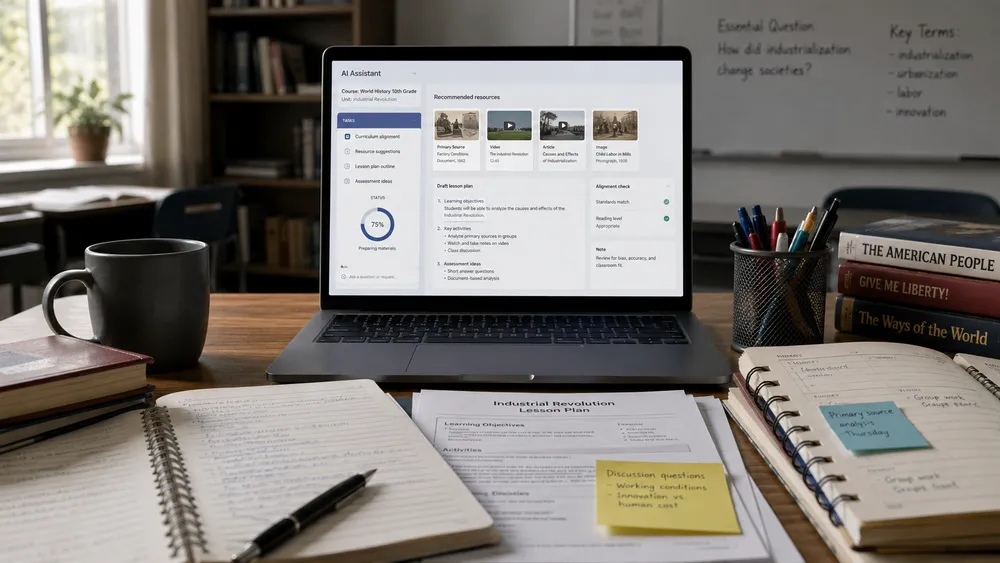
The offer includes premium access to Claude, education-specific skills, and a connector to Learning Commons, a system that allows Claude to access academic standards from all 50 states. That means teachers can ask Claude to help produce lesson plans or learning materials that are not only generic, but tied to specific standards, grade-level expectations, and skill progressions.
Anthropic also highlights access to curriculum resources such as OpenSciEd and Illustrative Mathematics IM v.360, as well as integrations with education tools including ASSISTments, Brisk Teaching, Canva Education, Diffit, Eedi, MagicSchool, Snorkl, and TeachFX.
The most important part of the announcement is the integration of Claude Code and Claude Cowork.
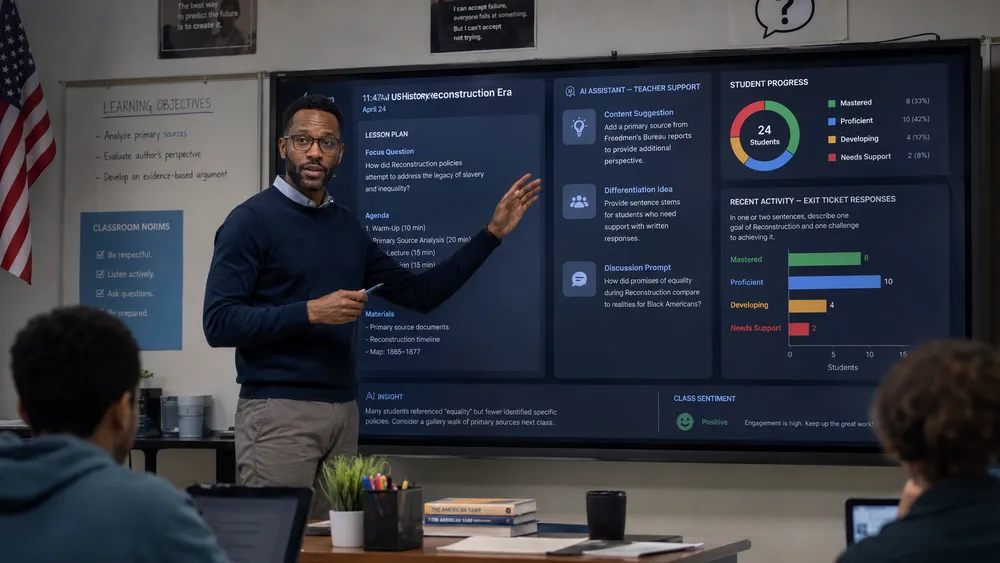
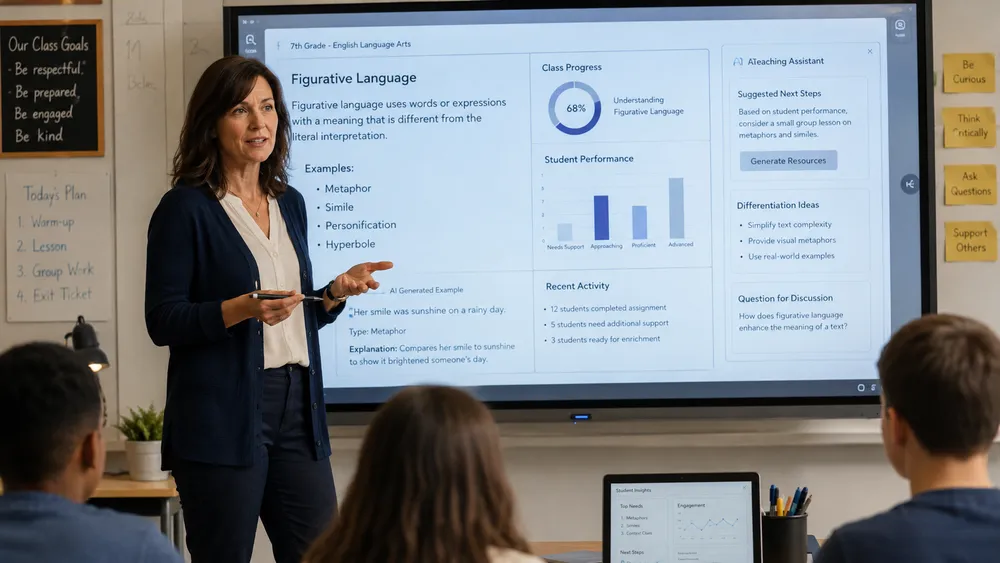
According to Anthropic, teachers can use Claude for Teachers to analyze classroom data such as diagnostic results, attendance records, grades, and student rosters. The tool can help identify patterns, adapt materials for different levels, and support recurring tasks. One example is asking Claude to review daily exit tickets and suggest how the next day’s lesson could be adjusted.
This is where the announcement becomes more than another AI lesson planner. Claude is being positioned as a tool that can work across multiple steps, connect to structured educational resources, and help teachers manage ongoing instructional workflows.
Why This Matters for U.S. Education
The launch of Claude for Teachers confirms a major trend in the education technology market: the largest AI companies no longer want to serve only universities, students, or enterprise customers. They want to enter the daily workflow of teachers.
That matters because teachers are not just occasional users of software. They make constant decisions: what to teach, how to explain it, when to reteach, how to differentiate, which student needs support, and how to communicate progress.
If AI becomes part of those decisions, the impact could be significant.
On the positive side, Claude for Teachers could reduce repetitive work. Teachers often spend hours adapting materials, writing rubrics, creating worksheets, preparing intervention groups, and rewriting instructions for different reading levels. A capable AI assistant can help produce drafts faster.
But this also gives Anthropic a direct pathway into one of the most sensitive parts of education: the professional judgment of teachers.
This is not happening in a vacuum. OpenAI has already introduced ChatGPT for Teachers, also free for verified U.S. educators for a limited period. Google is pushing Gemini for Education through the broader Google for Education ecosystem. Microsoft is integrating Copilot into education workflows through Microsoft 365 and its education products.
The competition is therefore not only about which model gives the best answer. It is about which company becomes the default AI layer for schools, districts, classrooms, documents, assignments, student data, and teacher productivity.
Claude as a Semi-Autonomous Teaching Agent
A chatbot answers questions. A copilot assists a human with a task. An AI agent can plan, use tools, perform multi-step actions, and support recurring workflows.
With Claude Cowork, Anthropic is moving Claude closer to that third category. The teacher is no longer only asking, “Write me a worksheet.” The teacher can ask Claude to monitor patterns, review recurring classroom inputs, and recommend changes over time.
That is a major shift.
For teachers, the potential is obvious. A system that helps analyze formative assessments, identify students who need reteaching, adapt explanations, generate differentiated resources, and prepare communication drafts could save time.
For districts, the value proposition is also clear. If Claude becomes part of planning, intervention, and documentation, it could become an infrastructure layer for teaching operations.
For Anthropic, this creates a long-term business opportunity. The free year is likely not only a public-service gesture. It is also an adoption strategy. If teachers build habits around Claude, schools and districts may later be more inclined to pay for institution-wide access, administration tools, compliance controls, and district-level deployment.
This does not make the offer bad. But it does mean the free model should be read strategically.
What Anthropic Does Not Clearly Say
Anthropic presents Claude for Teachers as a privacy-conscious, educator-friendly, productivity-focused tool. But several important questions remain open.
The first is evidence. Anthropic has not yet published large-scale data proving that Claude for Teachers improves student outcomes, reduces teacher workload over time, or produces more reliable instructional materials than existing methods.
The company has announced a future pilot with Detroit Public Schools Community District to study teacher well-being and classroom practice. That is important, but the results are not yet available. Until they are, the product’s educational impact should be treated as a promising hypothesis, not a proven outcome.
The second issue is responsibility. Even when Claude is used in an education-specific context, its outputs still need human review. An AI-generated lesson plan can be useful, but it can also include mistakes, weak assumptions, unsuitable examples, or misleading explanations.
This matters especially in subjects where precision is essential, such as math, science, history, civics, and literacy instruction.
The third question is pricing after adoption. The offer is free for one year for eligible teachers who sign up before June 30, 2027. But Anthropic also says a separate offering for schools and districts will come later. That suggests a classic education technology strategy: build individual educator adoption first, then sell institutional access.
The fourth unresolved point is international relevance. Claude for Teachers is built around U.S. K-12 standards and U.S. privacy law, especially FERPA. For teachers outside the United States, the product is important to watch, but it is not yet a globally adapted education solution.
Privacy and FERPA: A Strength, but Not a Complete Answer
Anthropic says data submitted to Claude for Teachers is not used to train its models. The company also says the product is governed by specific U.S. K-12 terms and a data-processing addendum designed around FERPA, the Family Educational Rights and Privacy Act.
That is an important commitment. In education, privacy is not a secondary detail. Teachers may handle student names, grades, attendance data, special accommodations, behavioral notes, assessment results, and family information.
Anthropic also says it uses security measures such as encryption, access controls, and internal safeguards. These are meaningful signals, especially compared with consumer-grade AI tools that may not be appropriate for student data.
But privacy protections do not remove every risk.
The most practical risk is user behavior. A teacher can still upload more information than necessary. A school can fail to train staff properly. A district can adopt an AI system without clear internal rules. A student’s situation can be indirectly identifiable even when names are removed.
There is also the issue of interpretation. When an AI tool analyzes classroom data, it may identify patterns that seem useful but are incomplete or misleading. Teachers and administrators must avoid treating AI-generated insights as objective truth.
In other words, FERPA alignment and contractual safeguards are necessary, but they are not enough. Real protection depends on training, governance, data minimization, and human review.
Who Can Really Benefit from Claude for Teachers?
The most immediate beneficiaries are U.S. teachers who spend significant time preparing differentiated materials. For example, a middle school teacher managing multiple reading levels could use Claude to generate several versions of the same explanation.
Elementary teachers may benefit from lesson planning, parent communication drafts, activity ideas, and reading-level adjustments.
Math and science teachers may find value in standards-aligned planning, especially through connections to resources like Illustrative Mathematics and OpenSciEd.
Instructional coaches, librarians, intervention specialists, counselors, and certified school staff may also benefit. Claude can help summarize materials, prepare guidance documents, adapt resources, and organize recurring support tasks.
For school administrators, the long-term value may be in workflow support: planning professional development, reviewing anonymized trends, preparing communications, and supporting curriculum alignment.
For EdTech startups, Anthropic’s open-source education skills are also worth watching. They show how a major AI company thinks about curriculum-aligned prompting, lesson differentiation, and structured teaching workflows.
For content creators and curriculum publishers, the message is clear: basic worksheets, generic rubrics, and simple lesson templates will become easier to generate. The value will move toward quality, trust, validation, originality, assessment design, and classroom-tested resources.
The Main Risks to Watch
The first risk is hallucination. AI models can generate fluent but incorrect content. In a classroom, that can create real learning problems.
The second risk is over-standardization. Standards alignment is useful, but teaching is not only about standards. It also depends on context, student relationships, local culture, classroom dynamics, and teacher judgment. If teachers rely too heavily on AI-generated materials, lessons may become more uniform and less responsive.
The third risk is platform dependency. A free year can create habits. Once teachers rely on Claude for planning, differentiation, and recurring analysis, districts may feel pressure to pay for access later.
The fourth risk is data sensitivity. Classroom data can be powerful, but it can also be misused or misread. AI-generated recommendations about student needs must never replace professional judgment.
The fifth risk is equity. If some teachers, schools, or districts have better access to AI tools than others, the gap between well-resourced and under-resourced classrooms may grow.
CritiquePlus View
At CritiquePlus, our view is clear: Claude for Teachers is a strategically important launch, but it should not be treated as proof that AI improves education.
The product is useful because it targets real pain points. Teachers are overloaded. Planning takes time. Differentiation is difficult. Data analysis is often messy. If Claude can help with drafts, adaptations, summaries, and recurring tasks, many teachers will benefit.
But the strongest part of the announcement is also the part that requires the most caution: Claude for Teachers moves AI from content generation toward educational workflow automation.
That is where the long-term impact will be. Anthropic is not simply offering free access to Claude. It is trying to make Claude part of how teachers think, plan, adjust, and organize classroom work.
For individual teachers, the recommendation is to test it carefully. Use it for drafts, lesson variations, brainstorming, communication templates, and low-risk planning tasks. Do not use it as an unquestioned authority.
For districts, the recommendation is to wait for stronger evidence, clear pricing, administrative controls, training materials, and results from pilot programs before adopting it widely.
For the broader U.S. education system, Claude for Teachers is a signal: the next phase of AI in schools will not be limited to students asking chatbots for help. It will be about AI becoming part of the teacher’s professional workflow.
What to Watch Next
The first thing to watch is the Detroit pilot. If Anthropic can show measurable improvements in teacher workload, planning quality, or classroom practice, the offer will become much more persuasive.
The second is the future district-level product. Pricing, admin controls, data governance, integrations, and compliance will determine whether schools adopt Claude at scale.
The third is competition. ChatGPT for Teachers, Gemini for Education, and Microsoft Copilot are all fighting for the same space: the teacher’s daily workflow.
The fourth is policy. Schools will need clear rules on what data can be uploaded, how AI-generated content should be reviewed, and how teachers should disclose or manage AI-supported materials.
The fifth is teacher training. The best AI tool is not automatically useful. Its value depends on how well educators understand prompting, verification, privacy, bias, and instructional design.
Key Takeaways
Claude for Teachers is a free one-year offer for verified U.S. K-12 educators who sign up before June 30, 2027.
It includes premium Claude capabilities, education-focused skills, a Learning Commons connector, curriculum resources, Claude Code, Claude Cowork, and recurring task support.
The product can help teachers save time, especially with lesson planning, differentiation, classroom data analysis, and instructional organization.
But Anthropic has not yet proven that Claude for Teachers improves student outcomes or reduces teacher workload at scale.
The biggest strategic point is that Anthropic is moving Claude toward a semi-agentic role in education. The company wants Claude to become part of how teachers plan, adapt, and manage classroom workflows.
For teachers, it is worth testing carefully. For districts, it is worth monitoring before large-scale adoption. For the education market, it is a sign that AI competition is moving from chatbots to classroom infrastructure.
Official Sources Used
Anthropic Newsroom — official announcement of Claude for Teachers, published July 14, 2026.
Claude Help Center — information about Claude for Teachers, privacy, eligibility, and data handling.
Anthropic U.S. K-12 Terms of Service — specific terms for K-12 education use.
Anthropic GitHub — official repository for K-12 teacher skills.
OpenAI — official page for ChatGPT for Teachers.
Google for Education — official page for Gemini for Education.
Microsoft Education — official page for Copilot in Education.
U.S. Department of Education — official FERPA resources on student privacy.
