
NVIDIA Jetson Thor T3000 and T2000: why these new modules could accelerate AI robotics
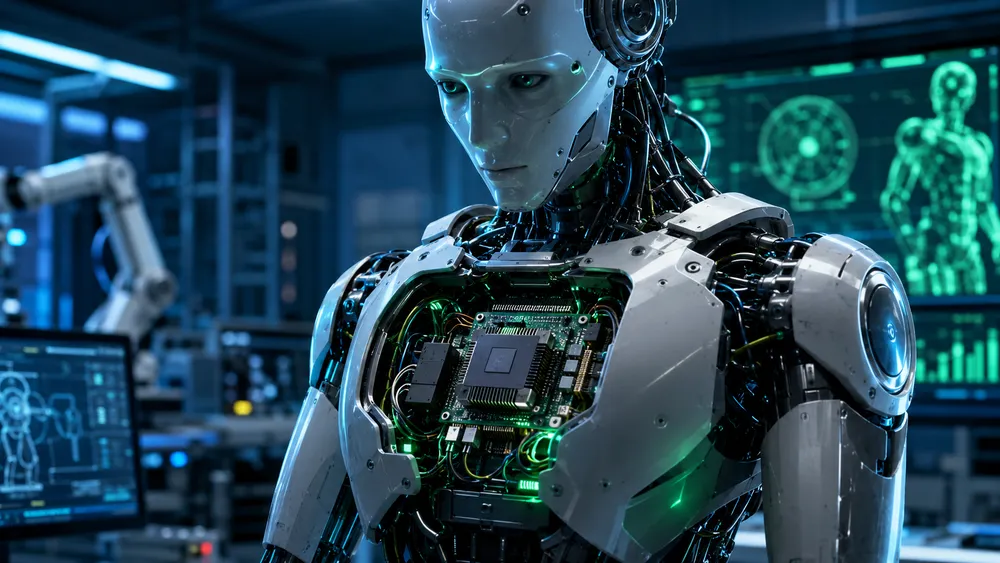
NVIDIA wants to place its Thor architecture at the heart of the next generation of robots. In an announcement published on July 15, 2026, on its official blog, the company introduced the Jetson T3000 and Jetson T2000, two compact computing modules designed for humanoid robots, autonomous machines, visual agents and embedded AI systems capable of running models directly at the edge, without constantly depending on the cloud.
This announcement matters because it is not just about a new chip. NVIDIA is pushing a complete platform for physical AI: Blackwell hardware, Jetson Thor architecture, open models such as Cosmos 3 Edge, Isaac tools, optimization agents and safety software. The promise is clear: enable robots to see, reason and act locally, with lower latency and greater control.
The critical question remains open: will these modules really democratize advanced robotics, or will they mainly strengthen manufacturers’ dependence on the NVIDIA ecosystem?
What are NVIDIA Jetson Thor T3000 and T2000?
The Jetson T3000 and Jetson T2000 are computing modules for robots and edge AI systems. They are designed to run artificial intelligence workloads locally, including multimodal models, vision-language models, vision-language-action models and world models used in robotics.
The Jetson T3000 is the more powerful of the two. According to NVIDIA, it combines a Blackwell GPU, an eight-core Arm Neoverse processor, 32 GB of LPDDR5X memory, 273 GB/s of memory bandwidth and 25 GbE connectivity. The company announces 865 teraflops FP4 of performance, in a format around twice as compact and more energy-efficient than the T5000.
The Jetson T2000 targets broader adoption. It offers 400 teraflops FP4 and 16 GB of memory, with a more accessible positioning for developers building visual agents, autonomous mobile robots, industrial manipulators or other intelligent machines.
In plain terms, NVIDIA is not only targeting spectacular humanoid robots. The cited use cases also cover industry, logistics, transportation, smart retail, autonomous systems and machines capable of interpreting their environment.
What is the difference between Jetson T3000 and Jetson T2000?
The main difference between the Jetson T3000 and Jetson T2000 lies in computing power, memory and target audience.
The T3000 is designed for more demanding systems: humanoid robots, complex autonomous platforms, heavy multimodal models, advanced perception and local inference on sophisticated workloads. With 32 GB of memory and 865 teraflops FP4, it targets integrators who need a high level of performance in an embedded format.
The T2000, by contrast, acts as a more accessible entry point into the Thor architecture for a wider range of projects. With 16 GB of memory and 400 teraflops FP4, it may interest developers who do not need maximum power but still want to run local AI functions on robots, smart cameras, industrial arms or autonomous vision systems.
This segmentation is strategic. NVIDIA is not simply trying to sell a high-end module. The company wants to cover a broader spectrum of machines, from the most advanced robots to more specialized edge AI systems.
When will Jetson T3000 and T2000 be available?
The Jetson T3000 and Jetson T2000 are not yet commercially available. NVIDIA expects availability in the first quarter of 2027. Developers can, however, start working with the Jetson AGX Thor Developer Kit and use an emulation mode to prepare their applications.
The T3000 emulation mode is expected to become available later in July 2026 with JetPack 7.2.1. Support for the T2000 emulation mode will follow in a later release.
This is an important point for companies. The window between the announcement and commercial availability gives robot manufacturers, industrial integrators and software vendors time to adapt their technical stacks. But it also means real-world performance will need to be evaluated later, under production conditions.
Can a robot use AI without an internet connection thanks to Jetson Thor?
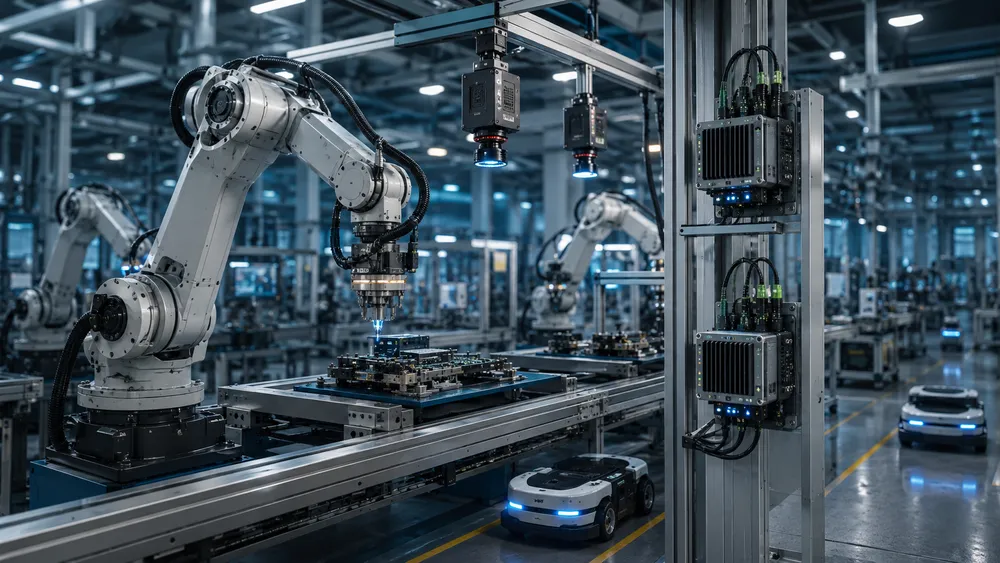
Yes, partly. The point of a module such as Jetson Thor is precisely to enable local execution of embedded AI models. A robot can therefore analyze video streams, understand a scene, detect objects, interpret instructions or generate certain actions without sending every request to a remote data center.
This is crucial for robotics. An industrial machine, a mobile robot or a traffic system cannot always wait for a response from the cloud. Latency, connectivity, privacy and service continuity require part of the computation to happen directly on the device.
But this should not be oversimplified. A robot can run local AI, but that does not mean it becomes fully autonomous, reliable or safe. Models can misinterpret a scene. Sensors can fail. Physical conditions can change. And robots operating near humans must keep safety systems that remain independent from the generative model.
Embedded AI reduces network dependency. It does not remove the need for validation, supervision, testing and safeguards.
Cosmos 3 Edge: what is NVIDIA’s embedded AI model for?
Alongside the Jetson T3000 and T2000, NVIDIA is also bringing Cosmos 3 Edge to the Thor family. This is a 4-billion-parameter model designed for embodied systems. Its purpose is to help robots see their environment, reason in real time, predict actions and generate behaviors through inference performed directly on the device.
On its official NVIDIA Cosmos page, the company presents Cosmos 3 as a foundation model for physical AI, capable of visual reasoning, action generation, world simulation and robotic policy training.
This is one of the most important parts of the announcement. NVIDIA is no longer only selling computing hardware. It wants to provide the software layer that allows robots to understand and act in the physical world.
For developers, the promise is attractive: train or adapt a model more quickly to a robot, vehicle, sensor or specific environment. But CritiquePlus recommends caution. A world model can help anticipate scenarios. It does not, by itself, guarantee precise movements, robustness in real-world environments or operational safety.
Why are Jetson optimization agents important for developers?
Another interesting development concerns Jetson agent skills. NVIDIA says these agents can automate memory optimization, system configuration and deployment tasks that previously required manual work and advanced technical expertise.
The company claims that some partners achieved significant gains. UBTech, Agile Robots and Connect Tech reportedly reduced memory usage by up to 15 GB, allowing them to move from a Jetson AGX Orin 64 GB module to a 32 GB configuration. Other cited examples include SandStar, GROOVE X and NoTraffic, with reduced memory consumption or improved headroom for adding AI capabilities.
This deserves attention because it shows an evolution in AI agents. Here, the agent is not only used to operate a robot. It also helps developers optimize the software environment in which the robot runs.
For a company, this can have a direct impact on costs. If optimization makes it possible to use a module with less memory, the final price of the robot may decrease. But these results remain selected cases provided by NVIDIA and its partners. They will need to be verified across diverse projects, under real constraints of maintenance, safety, energy consumption and software compatibility.
Why is NVIDIA Jetson Thor strategic for physical AI?
This announcement confirms a major trend: generative AI is gradually moving beyond text interfaces and entering the physical world. Models are no longer used only to write, code, summarize or generate images. They are starting to interpret scenes, manipulate objects, control machines and make decisions locally.
This is what NVIDIA calls physical AI. In this vision, a robot or autonomous machine must combine several building blocks: perception, reasoning, simulation, action modeling, safety, software optimization and embedded computing power.
Jetson Thor therefore becomes a central link. It does not replace sensors, motors, control systems or safety rules. But it provides a computing foundation for running locally the models that give machines a more advanced understanding of their environment.
For NVIDIA, the issue is also economic. After dominating data center AI with its GPUs, the company wants to strengthen its position in edge AI, robotics, autonomous vehicles, smart industry and physical machines. This is a logical extension of its strategy: making its chips, software and models a complete infrastructure for AI.
What NVIDIA does not clearly say about Jetson T3000 and T2000
The announcement is solid, but several areas remain unclear.
First, NVIDIA has not yet provided all details about the final cost of the modules, partner boards, integration, software development and support. In robotics, the module price is only one part of the total cost. Sensors, actuators, energy, thermal management, testing, safety, certification and maintenance must also be considered.
Second, the announced performance figures remain numbers communicated by NVIDIA. The 865 teraflops FP4 of the T3000 and the 400 teraflops FP4 of the T2000 are impressive on paper, but they are not enough to predict performance inside a real robot. Thermal, energy, software and mechanical constraints can significantly change the final experience.
Another point: embedded AI does not automatically solve safety issues. A robot using a multimodal model or a vision-language-action model can hallucinate, misinterpret an object, misunderstand an intention or produce an inappropriate action. The more AI acts in the physical world, the more sensitive its errors become.
Finally, this announcement reinforces dependency on the NVIDIA ecosystem. Developers benefit from a coherent stack with Jetson, Isaac, Cosmos, Nemotron, GR00T, Omniverse and optimization agents. But this coherence can also lock manufacturers into a hardware and software architecture that may be difficult to replace.
Who can really benefit from Jetson T3000 and T2000?
The first beneficiaries are robot manufacturers, industrial integrators and companies building autonomous systems. For them, the Jetson T3000 and T2000 can provide a more compact foundation for integrating local AI into machines capable of perceiving and acting.
AI developers may also benefit, especially if they work on vision, robotics, visual agents, embedded models or physical AI applications. The emulation mode announced by NVIDIA allows software preparation before the commercial availability of the modules.
Industrial SMEs and robotics startups should be more cautious. The potential is real, but adoption will depend on cost, partner board availability, documentation, software support and ease of integration.
Content creators, tech bloggers and trainers can also follow this announcement, not necessarily to buy these modules immediately, but because it sends a strong signal: the next AI wave will not be limited to chatbots. Topics around AI robots, edge AI, embedded AI, physical AI agents and hardware sovereignty will become increasingly important.
The limits and risks to watch before adopting Jetson Thor
The first limitation is availability. The Jetson T3000 and T2000 are expected in the first quarter of 2027, not for immediate production purchase.
The second limitation concerns safety. An intelligent robot must operate with multiple layers of control: AI model, business rules, redundant sensors, emergency stop systems, mechanical validation and human supervision. High computing power does not guarantee safe action.
The third limitation concerns privacy. Local execution can reduce certain transfers to the cloud, but robotic systems still involve sensitive data: factory images, video streams, mobility data, employee information, private spaces or critical infrastructure.
The fourth limitation is ecosystem lock-in. NVIDIA offers a powerful stack, but the more a company adopts Jetson, Cosmos, Isaac and related tools, the more it depends on NVIDIA’s roadmap.
Finally, competition will need to be monitored. Qualcomm, Intel, AMD, Chinese platforms, specialized chipmakers and embedded cloud players may try to offer alternatives. For now, NVIDIA retains an obvious lead in AI infrastructure, but robotics remains a more complex market than data center GPUs.
CritiquePlus opinion: is Jetson Thor a real innovation or a marketing signal?
The announcement of the Jetson T3000 and T2000 is more than a simple component launch. CritiquePlus sees it as a strong strategic signal: NVIDIA wants to become the reference infrastructure for AI robotics, just as it has already become central to much of generative AI in data centers.
The most interesting point is not only the announced power. It is the combination of Blackwell hardware, Cosmos 3 Edge models, optimization agents, Isaac tools, a complete software stack and partner ecosystem. NVIDIA is not just selling a module: it is building a platform to move AI from text into the physical world.
But a promising platform should not be confused with guaranteed autonomy. Robots equipped with Jetson Thor will not automatically become reliable, safe or able to handle all real-world situations. The transition from demonstration to production remains difficult: costs, certification, maintenance, safety, responsibility and field robustness all matter.
For developers and robotics companies, it makes sense to monitor and test now through the Jetson AGX Thor ecosystem if the project is serious. For non-specialized SMEs, it is better to wait for early production feedback in 2027. For media outlets, tech creators and trainers, the topic deserves strong editorial priority: it is one of the clearest announcements showing the shift toward physical AI.
Key takeaways on NVIDIA Jetson T3000 and T2000
NVIDIA announced the Jetson T3000 and T2000 on July 15, 2026, on its official blog.
The Jetson T3000 offers 865 teraflops FP4, 32 GB of LPDDR5X memory, 273 GB/s of bandwidth and a Blackwell GPU.
The Jetson T2000 offers 400 teraflops FP4 and 16 GB of memory, with a more accessible positioning for edge AI.
Both modules are based on the Thor architecture and target robots, visual agents, autonomous machines, industrial manipulators and embedded AI systems.
Cosmos 3 Edge is a 4-billion-parameter model designed to help robots see, reason and generate actions locally.
Commercial availability of the Jetson T3000 and T2000 is expected in the first quarter of 2027.
CritiquePlus recommends treating this announcement as a major evolution of the NVIDIA ecosystem, but not as proof that AI robots are immediately becoming autonomous, safe or mainstream.
Official sources used
NVIDIA Blog — “NVIDIA Introduces New Jetson Thor Computers to Advance Mainstream Robotics and Edge AI”, published on July 15, 2026.
NVIDIA Cosmos — official page dedicated to foundation models for physical AI and Cosmos 3 use cases.
