
NVIDIA Cosmos-H-Dreams: can generative AI train surgical robots without real-world risk?
NVIDIA wants to bring generative simulation into a field where mistakes are not just bad answers or software bugs: surgical robotics. In an announcement published on July 27, 2026 by the NVIDIA organization on Hugging Face, the company introduced NVIDIA Cosmos-H-Dreams, a real-time generative simulator designed to reproduce the likely visual consequences of a surgical robot’s movements.
The system starts from an initial image of the scene and a continuous stream of kinematic data describing the robot’s actions. It then generates the next visual frames in a closed loop, allowing a human operator, a robotic policy or a learning system to interact with a simulated surgical environment.
The ambition is clear: to let researchers test surgical gestures without constantly using a physical robot, expensive instruments or fragile biological material. But NVIDIA Cosmos-H-Dreams should not be described as an autonomous surgical robot. NVIDIA presents it as a research and development platform, not as a diagnostic system, a substitute for intraoperative imaging or a controller designed to operate directly on patients.
The question is therefore this: can generative video become a reliable enough environment for training surgical robots, or does it risk producing simulations that look convincing but remain physically incomplete?
NVIDIA Cosmos-H-Dreams: what NVIDIA announced
NVIDIA Cosmos-H-Dreams is an action-conditioned generative simulator specialized for surgical robotics. The system receives a context image, then a stream of robotic kinematics, and generates in real time the images corresponding to the likely consequences of those movements.
The announcement explains that this approach turns a surgical world model into an interactive environment controlled by either a human operator or a robotic policy.
The project builds on Cosmos-H-Surgical-Simulator, a world foundation model based on NVIDIA Cosmos-Predict2.5-2B and post-trained on the Open-H-Embodiment dataset. That earlier model could already generate future surgical video from an initial scene and a robot trajectory. Its main use cases were offline robotic policy evaluation and synthetic data generation.
With NVIDIA Cosmos-H-Dreams, NVIDIA moves this approach into real time. The published model is specialized for tabletop suturing tasks with the da Vinci Research Kit, or dVRK. It receives an initial RGB image and a stream of robot actions, generates the next blocks of frames, and continues with the next block of actions.
NVIDIA also says it collaborated with CMR Surgical and Cambridge Consultants to connect Cosmos-H-Dreams to the controller of the Versius surgical robot. Commands can be sent through a browser, keyboard or Meta Quest headset, while the generated scene is streamed back to the operator through WebRTC or WebXR.
Why NVIDIA Cosmos-H-Dreams matters for physical AI
The importance of NVIDIA Cosmos-H-Dreams goes beyond a video demonstration. The announcement touches one of the central problems of physical AI: how to train and evaluate robotic systems in realistic environments without relying only on slow, expensive and hard-to-reproduce physical experiments.
Surgical robotics is especially complex. Operating scenes include deformable tissue, thin instruments, sutures, needles, reflections, occlusions, sometimes smoke, and highly subtle physical interactions. Conventional simulators are useful, but these scenes are difficult to model manually in all their detail.
World models offer another path: learning visual dynamics directly from videos synchronized with robot movements. Instead of manually programming every physical interaction, the model learns to predict what should happen visually when a robot acts in a surgical scene.
This is where NVIDIA Cosmos-H-Dreams becomes strategic. A real-time generative simulator can serve as a training ground for robotic policies, a test bench for rare errors, a tool for synthetic data generation and a support system for rehearsing surgical gestures. NVIDIA is not merely trying to generate convincing videos. It is trying to turn generative video into an action environment.
How NVIDIA Cosmos-H-Dreams reaches real-time simulation
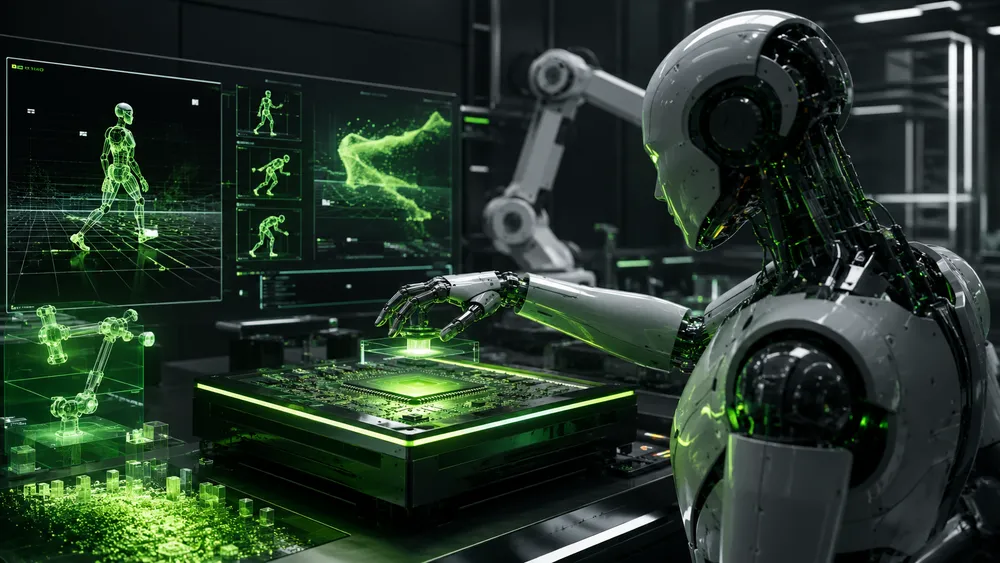
The move to real time relies on a key technical idea: distillation. NVIDIA Cosmos-H-Dreams starts from a teacher model, Cosmos-H-Surgical-Simulator, and distills it into a lighter causal student model capable of generating scenes autoregressively.
This approach aims to preserve the surgical dynamics learned by the heavier teacher model while sharply reducing generation cost.
NVIDIA describes several steps. The teacher model is first adapted to tabletop suturing data with the dVRK. The training mix includes successful demonstrations, but also failures and out-of-distribution episodes: dropped needles, missed stitches and failed knots.
That detail matters. A useful simulator should not only reproduce ideal gestures. It also needs to show the consequences of poor actions.
The student model is then trained to work with causal attention and a streaming key-value cache. NVIDIA also refers to a self-forcing distillation approach designed to reduce the gap between training, where the model can see clean context, and deployment, where it must condition its outputs on its own generated frames. This difference is crucial, because small errors can accumulate over long sequences.
The system can generate each latent frame with only a few denoising steps, sometimes just two, instead of a much heavier process. Inference is served by FlashDreams, an NVIDIA inference library for accelerated video and autoregressive world models. It combines continuous KV caching, CUDA Graphs capture and model compilation.
According to NVIDIA, these optimizations move inference from around 10 frames per second for the previous simulator to about 160 frames per second on a single NVIDIA RTX PRO 6000 GPU.
That number is impressive, but it applies to the configuration and use case presented by NVIDIA. It will need to be verified on other procedures, instruments, scenes and hardware constraints.
What NVIDIA Cosmos-H-Dreams could change for surgical robotics
The first potential benefit of NVIDIA Cosmos-H-Dreams is lower experimentation cost. Surgical robots are expensive, manipulations are delicate, trials are hard to repeat exactly, and failures can damage instruments or biological material. A generative simulator makes it possible to explore more scenarios without constantly using the physical platform.
The second benefit concerns rare errors. In surgical robotics, it is not enough to learn from successful demonstrations. Systems must also understand what happens when a needle drops, a stitch is misplaced, a knot fails or an instrument behaves unexpectedly.
NVIDIA emphasizes the importance of including these failures in the teacher model, because a robotic policy should be evaluated against bad actions, not only perfect gestures.
The third benefit is closed-loop learning. An offline simulator generates a sequence from a predefined trajectory. An interactive simulator allows a robotic policy or a human operator to act, observe the generated response, and adjust the next action. This loop turns the model into a training environment, not just a video generator.
The fourth benefit concerns research. NVIDIA has published the code, model, data and an adaptation guide. That could allow laboratories, universities and specialized teams to test the method, adapt it to other instruments, measure its limits and compare the simulation with real robot outcomes.
What NVIDIA does not clearly say about NVIDIA Cosmos-H-Dreams
The most important uncertainty is the sim-to-real gap: the difference between simulation and the real world. A generated video can be visually plausible without accurately reproducing forces, friction, depth, tissue tension, needle behavior or micro-interactions between instruments and biological matter.
This is a major limitation. In surgical robotics, visual credibility is not enough. A model may produce a convincing sequence while giving a robotic policy a misleading representation of the physical consequences of an action.
That would be especially dangerous if the system were used to validate behaviors without rigorous comparison against a real robot.
NVIDIA itself acknowledges that future evaluations must go beyond visual quality. The company highlights several areas to measure: tool tip position and pose accuracy, gripper cycle fidelity, rest-state stability, counterfactual action diversity, long-term drift and agreement between simulated outcomes and outcomes produced on a physical robot.
Another point requires clarification: the exact origin, diversity and limits of the data. The announcement mentions Open-H-Embodiment, JHU dVRK tabletop mixture and data related to the da Vinci Research Kit, but a deeper investigation should examine the volume of data, capture conditions, diversity of gestures, coverage of failures and the model’s ability to adapt to other surgical procedures.
Finally, the license and permitted uses should be examined carefully before any commercial or clinical use. The fact that code, model and data are available does not automatically mean the system can be freely used in a medical product, hospital environment or regulatory validation workflow.
NVIDIA Cosmos-H-Dreams is not an autonomous surgical robot
This point must be clear: NVIDIA Cosmos-H-Dreams is not an autonomous surgical robot. It is not a diagnostic system. It is not a live medical imaging tool. It is not a certified controller for operating on patients.
NVIDIA presents it as a research and development platform for exploring generative surgical simulation, training, synthetic data, robotic policy evaluation and future applications of physical AI.
This distinction is essential to avoid misleading headlines. The announcement is important, but it does not mean robots will soon operate on their own thanks to generative video. It means world models are becoming fast enough to be used in interactive loops.
For researchers, that is highly promising. For hospitals, it remains a technology to monitor, not a tool ready for direct clinical deployment. For industry, it is a signal: the next generation of medical robots may be trained not only with conventional physics simulators, but also with generative environments learned from real data.
The risks to watch with NVIDIA Cosmos-H-Dreams
The first risk is excessive trust in visually convincing simulation. The more realistic a generated video looks, the more tempting it becomes to trust it. But in surgery, visual realism does not replace mechanical, biomedical and regulatory validation.
The second risk is error accumulation over long sequences. NVIDIA recognizes that autoregressive models can suffer from temporal drift because they condition their outputs on their own generations. Even with self-forcing distillation, long-term stability remains a key evaluation point.
The third risk is generalization. A model trained on tabletop suturing tasks with a dVRK may not behave correctly on other procedures, tissues, instruments or robotic platforms. Adaptation to other datasets will therefore be decisive.
The fourth risk is regulatory. In medicine, a simulator used to train or evaluate a robotic policy could indirectly influence the safety of a future system. The issue is not only technical. It also involves responsibility, certification, data traceability and independent validation.
Who can really benefit from NVIDIA Cosmos-H-Dreams?
The first groups concerned are surgical robotics laboratories, physical AI research teams, medical robot manufacturers, universities and developers of robotic policies. For them, NVIDIA Cosmos-H-Dreams can become a tool for rapid experimentation, data generation, pre-evaluation and sim-to-real research.
Medical robotics companies may also see it as a way to accelerate development cycles. Instead of testing every variation on a physical robot, they can explore more trajectories in simulation before selecting the most relevant scenarios for real-world trials.
Researchers working on world models will find a concrete use case here. Unlike demonstrations in autonomous driving or video games, surgical robotics imposes fine constraints, delicate interactions and a much higher demand for robustness.
For the general public, physicians and patients, the impact is indirect. NVIDIA Cosmos-H-Dreams does not immediately change medical practice. But it shows how generative AI could eventually contribute to training, rehearsal, rare-scenario simulation and the improvement of surgical robots.
CritiquePlus verdict on NVIDIA Cosmos-H-Dreams
Our view is balanced: NVIDIA Cosmos-H-Dreams is an important announcement, but it should be presented as progress in simulation, not as surgical autonomy.
The progress is real. Turning a video model into an interactive environment at around 160 frames per second on a single RTX PRO 6000 shows that world models are starting to move from the lab toward usable training loops. The release of the code, model, data and adaptation guide also strengthens the scientific value of the project.
But the limitation is just as clear. A generative simulation is not proof of safety. It can accelerate learning, produce synthetic data and reduce some experimental costs, but it does not replace validation on a real robot, independent medical evaluation or regulatory certification.
For CritiquePlus, the central formula is this: NVIDIA Cosmos-H-Dreams does not create an autonomous robotic surgeon; it creates a generative training ground to test faster, learn more broadly and better understand possible errors.
That is already significant. But it is not yet a guarantee of reliable transfer to the operating room.
Key takeaways on NVIDIA Cosmos-H-Dreams
NVIDIA Cosmos-H-Dreams is a real-time generative simulator for surgical robotics, published by the NVIDIA organization on Hugging Face on July 27, 2026. It turns a surgical world model into an interactive environment capable of generating the likely visual consequences of robot actions.
The system is based on Cosmos-H-Surgical-Simulator, but uses distillation into a causal student model and FlashDreams to reach real-time performance. NVIDIA reports around 160 frames per second on a single NVIDIA RTX PRO 6000 GPU.
The potential is significant for training, evaluation, synthetic data and physical AI research. But the limitations remain major: simulation-to-reality gap, tissue fidelity, long-term stability, generalization to other procedures, medical validation and regulatory responsibility.
For CritiquePlus, NVIDIA Cosmos-H-Dreams is important because it shows that generative AI is no longer only used to produce text, images or videos. It is starting to become an interactive environment for training robotic systems. But in surgery, simulated interaction is not enough: the proof will have to come from rigorous comparison with the real world.
Official sources used
Primary official source: “NVIDIA Cosmos-H-Dreams: Bringing Real-Time Generative Simulation to Surgical Robotics”, published on July 27, 2026 by the NVIDIA organization on Hugging Face.
Related technical resources mentioned in the announcement: Cosmos-H-Dreams repository, NVIDIA Cosmos-H-Dreams checkpoint, Cosmos-H-Surgical-Simulator model, Open-H-Embodiment dataset, FlashDreams library, adaptation guide and NVIDIA Cosmos-Predict2.5 resources.
